He went on his way through towns and villages, teaching and journeying toward Jerusalem. And someone said to him, “Lord, will those who are saved be few?” And he said to them, “Strive to enter through the narrow door. For many, I tell you, will seek to enter and will not be able.
Luke 13:22-24 (ESV)
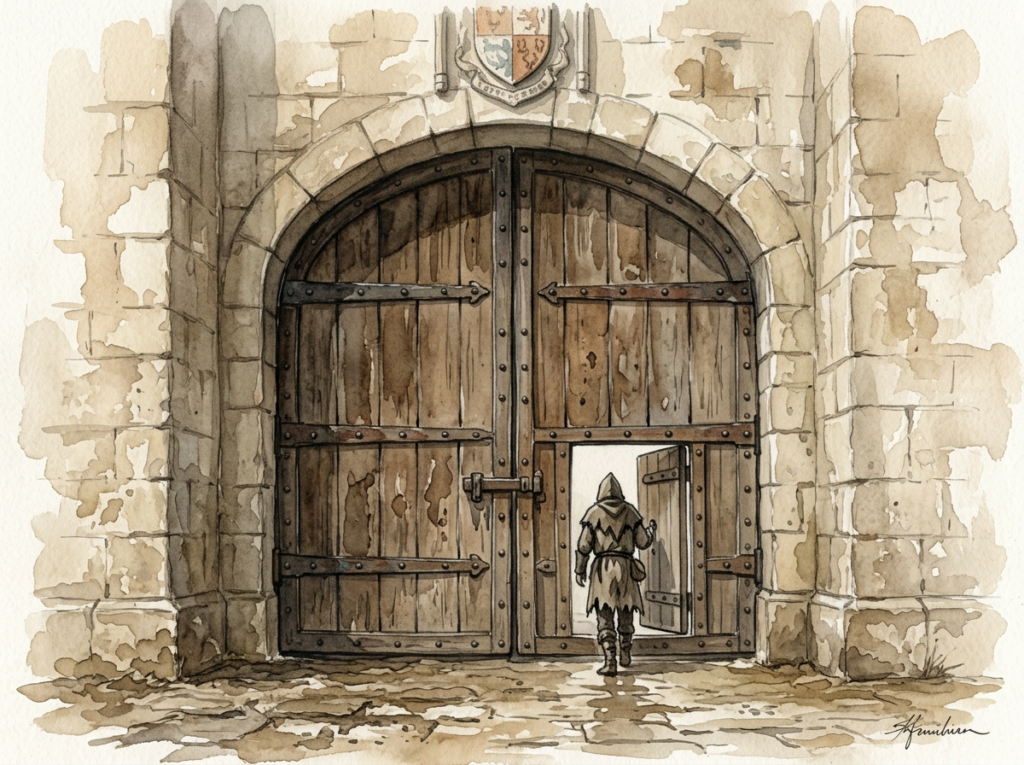
In John Bunyan’s timeless classic, Pilgrim’s Progress, we read how Evangelist directs Pilgrim, later known as Christian, towards the “Wicket Gate.” This gate is the starting point by which Pilgrim might be saved from the city of Destruction. Initially, he is unable to even see the gate, as his eyes are full of tears, and it remains far away. He can, however, make out a small light and is instructed to go towards that light. A “wicket gate,” as referred to in medieval times, was a narrow door commonly placed within much larger city gates. This was a small access point through which only one person might enter or exit at a time. Pilgrim is instructed to enter the wicket gate, which is to be the official starting point of his journey. However, there are many pitfalls, dangers, and setbacks before he even reaches this required door, and several challenges that nearly thwart his quest before it begins.
In the book of Luke, Christ bids us “strive to enter through the narrow door.” There are several points of significance in the passage. First, notice how Jesus is “…journeying towards Jerusalem.” He’s on His way to the cross. He’s heading directly into suffering. This is the road all of us, who claim discipleship, are required to traverse. It is the road Pilgrim is on, which ultimately leads to his own inexpressible loss and eventual death. As Jesus and His disciples made their way to Jerusalem, we read how they visited many places so that Jesus might preach the good news. At some point, “someone” asked the burning question everyone was thinking: “Lord, will those who are saved be few?” The answer was a resounding “yes!”
Today, we see a Christian culture that has methodically and quite effectively removed the narrow door from the gospel. Commonly known as an “altar call,” the evangelistic practice of grossly over simplifying the requirements of discipleship has inexplicably led thousands directly to hell. This wide-road invitation style was popularized and made a global phenomenon in the mid-20th century by evangelist Billy Graham. Though its roots date back to such protestant leaders as Charles Finny and D.L. Moody, the watered-down gospel call has always found popularity within the modern church.
Let me speak plainly. Our churches and pastors, leaders and theologians, have completely removed the high cost required for salvation as plainly stated in scripture. In an attempt to make Jesus more attractive and “seeker-friendly” as commonly termed, the choice to become a Christian is as inconsequential as choosing what to eat at McDonalds. We routinely invite people to “give their lives to Jesus,” but fail to explain the true requirements involved. We make discipleship little more than a few therapy sessions and Christian living simply noble community service. A thirty-second parroted prayer, a couple of basic conversations with a youth leader or pastor, perhaps an emotionally charged baptism, and presto, you’re a Christian. Saved, sealed, and delivered. Of course, we make sure to emphasize the proof needed for salvation, the necessity of continual Sunday school learning and the basic moral requirements of Christianity. But walking closely with Jesus, picking up the cross He requires of us, laying down our lives, and giving up all remains totally absent from the calling.
For which of you, desiring to build a tower, does not first sit down and count the cost, whether he has enough to complete it? Otherwise, when he has laid a foundation and is not able to finish, all who see it begin to mock him, saying, ‘This man began to build and was not able to finish.’Or what king, going out to encounter another king in war, will not sit down first and deliberate whether he is able with ten thousand to meet him who comes against him with twenty thousand? And if not, while the other is yet a great way off, he sends a delegation and asks for terms of peace. So therefore, any one of you who does not renounce all that he has cannot be my disciple.
Luke 14:28-33 (ESV)
I have spent the last two decades or more as a small business entrepreneur. I’m not particularly gifted at business, but I have learned a great deal along the way. The two fundamental principles of any successful business venture are learning to effectively manage expenses and develop realistic income projections. In other words, basic planning and strategic goal management are imperative skills. Many of the business decisions I’ve been forced to consider over the years had the potential to make or break everything. It was win or lose, fail or succeed. Such consequences on the line required much deliberation, number crunching, study, and a tremendous amount of prayer, surrender and ultimately, faith to move forward.
In Luke 14, Jesus compares the discipleship calling to a building project. Like any business endeavor, He sites the numbers that need to be crunched and details that require planning for such a project. He then takes the parable to the next level by liking it to a king going to war, a truly life and death scenario. Whether running a business, building a tower, or fighting an enemy, becoming a true believer in Jesus demands everything. You say you want to be a Christian, you’d better learn what price you’re required to pay. You want to become a disciple of Jesus? You do well to first learn His “terms of peace” before you find yourself falling into the hands of an angry God. In short, it remains imperative that we clearly know and understand what He demands of us.
Enter by the narrow gate. For the gate is wide and the way is easy that leads to destruction, and those who enter by it are many. For the gate is narrow and the way is hard that leads to life, and those who find it are few.
Matthew 7:13-14 (ESV)
Once again, Christ is echoed in the book of Matthew. The wicket gate is very narrow. Not some mass praise and worship-filled revival experience or late-night mission trip conversion event. It’s one at a time through the narrow door. It’s you, alone, escaping Beelzebubs arrows close at heel (read Pilgrim’s Progress). It’s leaving your boats and nets as did the first disciples. Or in modern terms, leaving your means of security and comfort. Placing your face in the dust, quietly contemplating everything that must be given up to follow Him. Even with all this, it’s important to never forget that many simply “will not be able” to enter the narrow gate, let alone walk the narrow road. Over and over again, scripture warns us that many are called, but few are chosen (Matthew 22:14). It’s not as simple and compromisingly comfortable as we like to believe. Time to wake up, dear friends, and consider the high cost of following Jesus. Strive to enter His Wicket Gate and resist the urge to widen and ease the steep calling of genuine discipleship.
And a scribe came up and said to him, “Teacher, I will follow you wherever you go.” And Jesus said to him, “Foxes have holes, and birds of the air have nests, but the Son of Man has nowhere to lay his head.”
Matthew 8:19-20 (ESV)